Jawaker Hand, Tarneeb & Trix
- 4.8
- Rating
- 10.00M
- Installs
- Free
- Price

 Analysis by App-foxy
I approached Jawaker Hand, Tarneeb & Trix expecting a straightforward digital card game, but it feels more like a social table built around familiar play. Its strongest idea is not simply putting cards on a phone. It brings several favorite card games together, adds conversation between players, and makes it easy to return to the same kind of relaxed competition whenever I have a few spare minutes. That combination explains why it has become such a recognizable choice in mobile card gaming.
My overall view is positive, with one important qualification: this is best when you want a connected, people-focused card experience rather than a quiet solo game. The free entry makes it easy to try, and the Everyone age rating keeps the presentation broadly accessible. At the same time, the social side can be a distraction if you only want to play against computer opponents or avoid any pressure associated with optional purchases.
What playing Jawaker feels like in everyday use
Jawaker is a card game from Jawaker, and it sits firmly in the social side of the card category. The store summary focuses on playing favorite card games and chatting with friends, which matches the way I experienced it: the cards are the reason to open the app, but the people around the table are what give repeated sessions their character.
You May Also Like

 Blood Strike: 2.5 Anniversary
Blood Strike’s Loadouts Turn Every Drop Into a Tactical Gamble
A close look at Blood Strike’s custom loadouts: how fast access to signature weapons reshapes its battle royale rhythm, rewards preparation, and narrows the gap between fights.

 Pandora - Music & Podcasts
Pandora’s Music Is Easy to Start, but Harder to Recover
Pandora’s strength is its low-effort path from a seed to a station. Its weak spot is how much confidence it asks you to place in connection, setup, and quiet recovery.

 8 Ball Pool
 Is Built on Rivalries, Rematches, and Routine
A close look at the rivalries, rematches, shared routines, and unanswered safety questions that turn a quick pool match into a persistent mobile community.

 Samsung Music
’s Quiet Strength Is Playing What You Already Own
Its reach comes less from spectacle than from dependable access to a personal library. That simplicity is both the app’s strongest retention engine and its ceiling.

 AccuWeather: Weather Radar
AccuWeather Review: A Quick, Clear Forecast for Everyday Decisions
For everyday plans, the best forecast is the one you can understand quickly. AccuWeather makes rain timing, radar, and local conditions easy to act on, with a few trade-offs.

 Hill Climb Racing
Why Hill Climb Racing Still Turns Crashes Into One More Run
A tiny car, a bumpy hill and one more upgrade: Hill Climb Racing keeps resurfacing because its simple chaos makes every near-miss feel personal.
More From Our News Desk
View All News


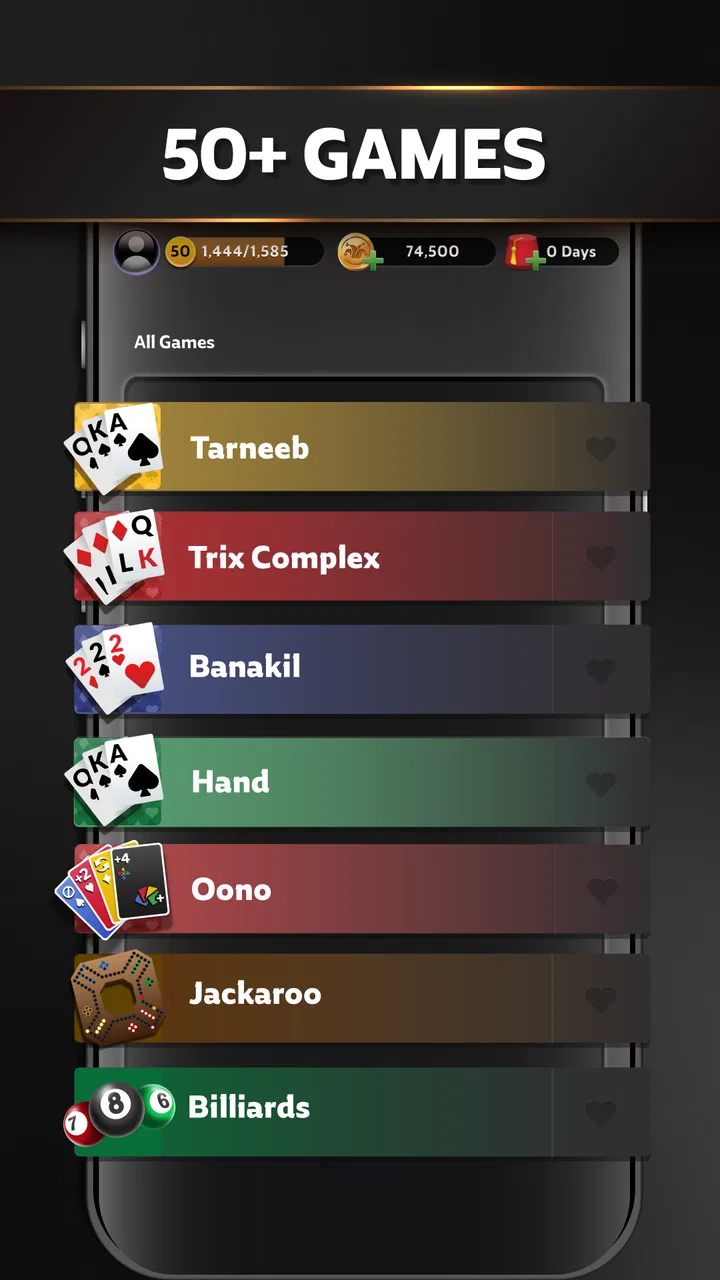
The most useful way to think about it is as a digital meeting place for players who already enjoy games such as Tarneeb and Trix. Instead of keeping separate apps for different card habits, I can stay in one environment and move between familiar styles of play. That makes it particularly convenient for friends who do not always want the same game every evening.
A realistic example is a short break after work. I might open the game intending to play one round, discover that a friend is available, and spend longer than planned because the conversation and changing pace make the session feel less repetitive than a solo puzzle. On another day, I may simply want a quick card match without arranging a physical deck or finding a table. That flexibility is one of its clearest practical strengths.
It is also worth setting expectations about the experience. This is not a traditional offline deck that I can treat as a completely private pastime. The social design is central, so the quality of a session depends partly on the players, the room, and how comfortable I am with chatting while playing. If that sounds appealing, the app has a natural advantage over a basic card simulator.
Why the game collection matters
The inclusion of Tarneeb and Trix gives the app a more specific identity than a generic solitaire title. Players who already know those games can concentrate on decisions instead of learning an unfamiliar ruleset from scratch. For newcomers, the benefit is variety: there is more reason to explore than there would be in an app built around only one classic format.
That variety also changes how I use it. I do not need to commit to one style every time I open the app. A game that feels too demanding after a long day can be replaced by another option, while a more competitive mood gives me a reason to stay longer. This is a small design advantage, but it is more meaningful than simply having a large menu. Different card games ask for different levels of attention, and switching can keep the experience from becoming stale.
There is a trade-off, though. A broad collection can make the first visit feel less focused than a dedicated Tarneeb or Trix app. Someone who wants one perfectly streamlined ruleset may prefer a specialist alternative. Jawaker is more convincing for players who value choice and social continuity over a single-purpose interface.
The social layer is a real strength, not decoration
Chatting while playing changes the rhythm of a match. A card decision is no longer isolated from the people at the table, and a win or mistake can become part of a shared exchange rather than a silent result screen. I found that this makes casual sessions feel warmer and gives friends a reason to return even when they are not treating every round as a serious contest.
There is a useful distinction here between playing with friends and playing with unknown opponents. Friends can make the app feel like a replacement for a physical gathering, especially when everyone already understands the games. Playing with unfamiliar people offers more availability, but it may not provide the same sense of trust or relaxed conversation. I would choose the app confidently for an established group and be more selective about how much social interaction I want in open play.
For families or mixed-experience groups, the Everyone rating is reassuring in broad terms, but the practical experience still depends on how people communicate. The rating does not turn every social interaction into a perfect fit. I would still treat the chat element as something to use thoughtfully, particularly when younger players are involved.
Small habits that make sessions better
My first tip is to decide before opening the app whether I want competition, practice, or conversation. That simple choice prevents me from judging a casual table by the standards of a serious match. When I want to improve, I pay attention to the decisions that led to a lost round instead of blaming a single unlucky card. When I want to unwind, I choose the game and table that keep the mood light.
My second tip is to use the variety strategically. If one game has started to feel predictable, changing to another is more effective than forcing myself through several tired rounds. The app’s value comes from the combination of games, not from treating one title as the only reason to stay.
A third useful habit is to separate social enjoyment from spending. The game is free to download and play, while optional in-app purchases range from $0.49 to $249.99 per item. That is a very wide range, so I would approach purchases carefully and decide on a personal limit before browsing anything optional. The free starting point is a genuine advantage, but it should not be confused with an experience where every possible enhancement is automatically cost-free.
I also recommend giving yourself time to adjust to the pace of online play. A physical table allows everyone to pause naturally, explain a move, or reshuffle the mood. A mobile match can feel more immediate. New players may enjoy the convenience but still need a few sessions before the timing and social flow feel natural.
Where the experience can be frustrating
The biggest limitation is that the social design can work against players who want complete control over their environment. If I am looking for a calm, uninterrupted game with no conversation, a solo card app is a better match. Jawaker’s appeal is tied to interaction, so avoiding that element removes part of what makes it distinctive.
There is also a difference between knowing the rules and being comfortable in a competitive room. Experienced players may move quickly or expect others to understand conventions that are not obvious to newcomers. That can make the first sessions feel less welcoming than a tutorial-focused alternative. I would not recommend judging the whole app after one awkward table; I would, however, acknowledge that the learning curve is partly social rather than purely mechanical.
The free model deserves the same balanced treatment. Being able to start without paying is helpful, especially for someone deciding whether the collection suits them. The presence of purchases means I would keep an eye on the boundary between optional extras and the feeling of being encouraged to spend. Players who dislike any form of monetization may be more comfortable with a paid app that offers one fixed purchase and a quieter structure.
Another limitation is audience fit. A person who wants a deep, tournament-style card platform with extensive analysis tools may find this more casual and social than expected. Conversely, someone who only wants a few minutes of solitaire may find the online table format unnecessarily busy. Jawaker works best in the middle: players who enjoy recognizable card games and appreciate having other people nearby.
Who should download it
I would recommend it first to players who already enjoy Tarneeb or Trix and want a convenient way to play when a physical group is unavailable. It is also a strong option for friends who want their card game and conversation in the same place. The combination is more persuasive than either feature alone.
It suits casual players who like variety, too. You do not need to approach every session as a serious test of skill. The ability to move between different card games gives the app enough range for changing moods, and the free price makes experimentation less risky. Its broad Everyone rating also makes it easier to consider for a mixed-age household, provided the social side is handled sensibly.
I would be more hesitant to recommend it to someone who wants a completely offline experience, dislikes chatting during games, or prefers a single polished ruleset with no distractions. A dedicated solitaire app is better for quiet solo play. A focused specialist game may be better for players who care more about one ruleset than a wider social collection. A fixed-price premium card game may also be preferable for anyone who wants to avoid optional purchase prompts entirely.
Device compatibility is reasonably approachable for older Android users because the current version, 28.2.76, requires Android 6.0 or later. That does not guarantee the same feel on every phone, but it means the app is not restricted to only the newest Android hardware. I would still make sure the device has enough comfortable screen space for reading cards and following a table without squinting.
Popularity, longevity, and what they mean
The app has been available since May 5, 2014, so it is not a new experiment trying to prove that mobile card gaming can be social. Its longevity gives the concept credibility: the format has had time to become established, and the large audience suggests that it has found a durable place among players who enjoy this style of game.
Its average rating is 4.8 from around 791 thousand ratings, with roughly 12 thousand written reviews, and it has passed 10 million installs. Those figures do not guarantee that every table will suit every person, but they do tell me that Jawaker is not an obscure card app with an untested community. There is a meaningful audience behind the experience, which matters when a game depends on finding other people to play with.
Popularity can have a downside as well. A large community brings more variety in skill, expectations, and communication styles. I see that as a reason to choose tables carefully rather than as a reason to reject the app. The same scale that creates occasional friction also makes the social model more practical than it would be in a nearly empty game.
My final assessment
Jawaker succeeds because it understands that card games are often about the table as much as the deck. Tarneeb and Trix give it a clear foundation, while chat and the wider collection make it more useful than a basic digital deck. I especially like it for spontaneous sessions with friends, for switching between different card moods, and for keeping a familiar style of play available without arranging a physical gathering.
Its weaknesses are closely connected to its strengths. The social layer may feel intrusive to solitary players, the learning experience can depend on the people at the table, and optional purchases mean that free access still deserves sensible boundaries. None of those issues makes the app a poor choice, but they do make the recommendation more specific.
For me, the verdict is clear: choose it if you want a social card table with familiar games and room for conversation. Skip it if your ideal card game is silent, offline, single-purpose, and completely free from optional spending. For the right player, Jawaker is not merely a collection of mobile card rounds; it is a convenient way to keep the social habit of playing cards alive.
FAQs for Jawaker Hand, Tarneeb & Trix
01What is Jawaker Hand, Tarneeb & Trix?
Jawaker Hand, Tarneeb & Trix is a popular mobile app that offers a collection of traditional card games. It includes favorites like Hand, Tarneeb, and Trix, allowing users to play with friends or other players online. The app provides an authentic card-playing experience with a user-friendly interface and engaging gameplay.
02Is Jawaker Hand, Tarneeb & Trix free to play?
Yes, Jawaker Hand, Tarneeb & Trix is free to download and play. However, the app offers in-app purchases for additional features, such as premium memberships, ad removal, and virtual currency to enhance your gaming experience. These purchases are optional and not required to enjoy the core gameplay.
03Can I play Jawaker Hand, Tarneeb & Trix offline?
Jawaker Hand, Tarneeb & Trix is primarily designed for online play, allowing you to connect with friends or other players worldwide. However, the app does not currently support offline play. To enjoy the games, a stable internet connection is necessary to ensure seamless gameplay and interaction with other players.
04What platforms support Jawaker Hand, Tarneeb & Trix?
Jawaker Hand, Tarneeb & Trix is available on both Android and iOS platforms. You can download the app from the Google Play Store for Android devices and the Apple App Store for iOS devices. Ensure your device meets the app's compatibility requirements for optimal performance.
05How does Jawaker ensure fair play and security?
Jawaker employs several measures to ensure fair play and security within its app. The platform uses a random card shuffling algorithm and has a dedicated team monitoring gameplay for any unfair practices. Additionally, user data is protected with encryption, ensuring a safe and secure gaming environment for all players.
Pros
- Wide variety of card games available.
- User-friendly interface for easy navigation.
- Smooth multiplayer experience.
- Customizable game settings.
- Frequent updates with new features.
Cons
- Requires a stable internet connection.
- In-app purchases can be pricey.
- Ads may be intrusive for some users.
- Limited offline functionality.
- Occasional bugs in older devices.

Jawaker Hand, Tarneeb & Trix
Gallery